Easter Story
“Easter,” she would say gently, “is about new life. Not just flowers blooming or eggs hatching, but something deeper, something personal.”

Easter Story
© April 4, 2026 JG with ChatGPT
“Easter,” she would say gently, “is about new life. Not just flowers blooming or eggs hatching, but something deeper, something personal.”
Every year, right around Easter, my Uncle Ramon insists on telling the “true story” of the holiday, which, depending on how much coffee he’s had, includes a rabbit with a union job, a basket economy, and at least one mildly confused chicken.
“Listen,” he said that one spring morning, tapping the kitchen table like a professor about to defend a thesis, “people think Easter is about candy and eggs. But it’s actually about a rock.”
“A rock?” I asked.
“A very important rock,” he said. “One that got moved.”
My cousin Lila leaned in. “By the bunny?”
Uncle Ramon squinted. “We’ll get to the bunny in a minute” he promised.
Now, I grew up with two competing Easter traditions.
There was the chocolate, pastel-colored, egg-hiding, sugar-fueled festival that made dentists quietly optimistic. And then there was the quieter, older story my grandmother told. The one that spoke of sorrow, hope, and something astonishing happening at sunrise.
“Easter,” she would say gently, “is about new life. Not just flowers blooming or eggs hatching, but something deeper, something personal.”
She would pause, letting the silence do some of the work.
“It’s about the day people believed that death didn’t get the last word.”
Uncle Ramon, however, preferred a more… well, let’s say “theatrical approach”.
“Picture this,” he would say, standing up dramatically in the kitchen. “Ancient times. Serious people. Sand everywhere. Suddenly, Bam! Something unbelievable happens. And no one quite knows how to process it.”
“That’s historically vague,” I said.
“Details, details,” he waved me off. “The point is, something happened that made people rethink everything; their fears, failures, forgiveness, all of it!”
Lila raised her hand. “Is this where the bunny comes in?”
Uncle Ramon sighed. “No. The bunny comes much later. The bunny is… well, let’s be honest here, a marketing decision.”
The origin of Easter, as best as my grandmother explained it, centered on the story of Jesus Christ; his suffering, his death, and then, in a twist no one expected, the belief in his resurrection.
“It’s a story about love that doesn’t quit,” she told me once. “Even when everything looks finished.”
“And people believe that really happened?” I asked.
She smiled. “Many do. And many others find meaning in the story, even if they’re still asking questions.”
That’s the part no one tells you when you’re a kid hunting for eggs: Easter isn’t just about finding things, it’s about understanding what’s been found.
Or what could be.
One year, I decided to investigate the whole thing like a youthful looking detective with a chocolate smudge on his face.
I sat down with Uncle Ramon.
“Okay,” I said. “Let’s break this down. Why is Easter such a big deal for Christians?”
He leaned back, surprisingly thoughtful.
“Because it’s the heart of everything,” he said. “The idea that love is stronger than fear. That forgiveness matters. That even when things look completely lost, there’s still hope.”
“That’s… actually pretty deep,” I admitted.
“It has layers,” he said. “Like a very emotional onion.”
Later, I asked my friend Jordan, who doesn’t consider himself religious.
“So what does Easter mean to you?” I asked.
He shrugged. “Honestly? It’s still meaningful. The idea of starting over, of things getting better, that’s not just a religious idea. That’s being human.”
“So you don’t have to be Christian to get something out of it?”
“Not at all,” he said. “Hope is kind of universal.”
That stuck with me.
Because whether you see Easter as a historical event, a spiritual truth, or a powerful story, its themes show up everywhere:
Second chances.
Forgiveness.
The possibility that things can change.
Even Uncle Ramon, who once tried to microwave a chocolate bunny “for science,” believes in second chances.
“Now,” Lila announced one afternoon, “we need to address the bunny.”
“Yes,” I agreed. “We’ve been very patient.”
Uncle Ramon cleared his throat.
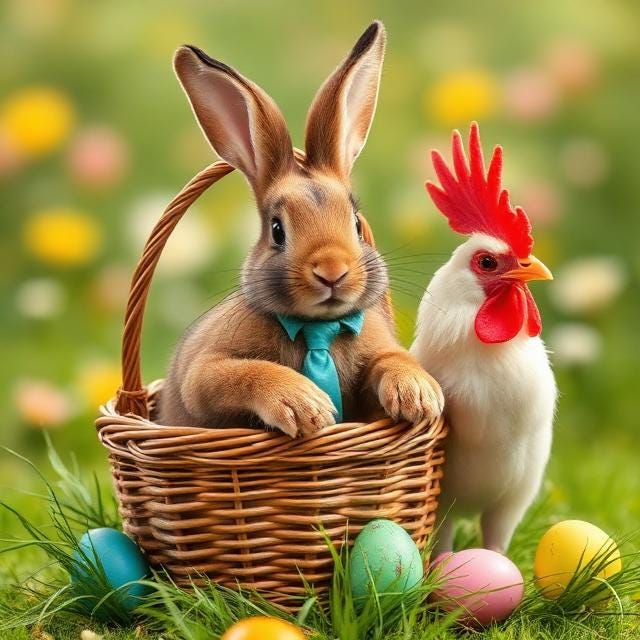
“The Easter Bunny,” he said solemnly, “is a symbol.”
“Of what?” Lila asked.
“Of… efficient candy distribution.”
“That’s not a real symbol,” I said.
“Fine,” he relented. “Rabbits have been symbols of new life for a long time. They multiply quickly, they represent spring, renewal…all that.”
“And the eggs?” I asked.
“Also symbols of new life,” he said. “Though considerably less mobile.”
“So the bunny is basically a delivery system for philosophical ideas?” Lila said.
“Exactly,” he said. “A fuzzy philosopher with a basket.”
That night, I lay in bed thinking about everything I’d heard.
The serious story.
The hopeful themes.
The questionable rabbit.
And I realized something surprising:
Easter works on multiple levels.
For some, it’s a sacred celebration of faith in Christianity. It’s a reminder of sacrifice, redemption, and the belief in life beyond death.
For others, it’s a season of reflection. It’s a chance to reset, to forgive, to begin again.
And for kids (and certain adults), it’s an excellent excuse to eat chocolate before breakfast.
The next morning, on Easter Sunday, I joined my family outside.
The air smelled like fresh grass and possibility.
“Ready for the egg hunt?” Lila asked.
“Always,” I said.
As we searched, I noticed something.
Some eggs were easy to find. They were bright and colorful, obvious and practically waving at you.
Others were hidden carefully, requiring patience and attention to find.
It all felt… well, symbolic.
“Life’s kind of like this,” I said.
Lila looked at me. “You’ve been talking to Grandma again.”
“Maybe,” I admitted.
After the hunt, we sat together, baskets full.
Uncle Ramon raised his coffee cup.
“To Easter,” he said.
“To new beginnings,” my grandmother added.
“To chocolate,” Lila said.
We all nodded.
“So,” Lila asked finally, “should we believe in the Easter Bunny?”
There was a pause.
Uncle Ramon leaned forward.
“Here’s the thing,” he said. “Belief isn’t always about whether something is literally true. Sometimes it’s about what that belief points to.”
“Like what?” she asked.
“Joy,” he said. “Generosity. Wonder. The idea that someone, or something, might surprise you with goodness when you least expect it.”
Lila considered this.
“So… the bunny is real?”
“In spirit,” he said.
“In chocolate,” I added.
She smiled. “I’ll take both.”
As the day went on, I realized that Easter wasn’t about choosing between the bunny and the deeper story.
It was about understanding that both, one playful, one profound, point toward something essential:
That life can begin again.
That kindness matters.
That hope, however small, is worth holding onto.
Moral
Easter reminds us that renewal, hope, and compassion are not limited to one day or one belief system. Whether through faith, reflection, or simple acts of kindness, its values invite us to live with forgiveness, generosity, and courage all year long. And while the Easter Bunny may be a symbol, the joy and meaning it carries are very real indeed.
For more short stories, click on this link: